About
I never set out to be a teacher.
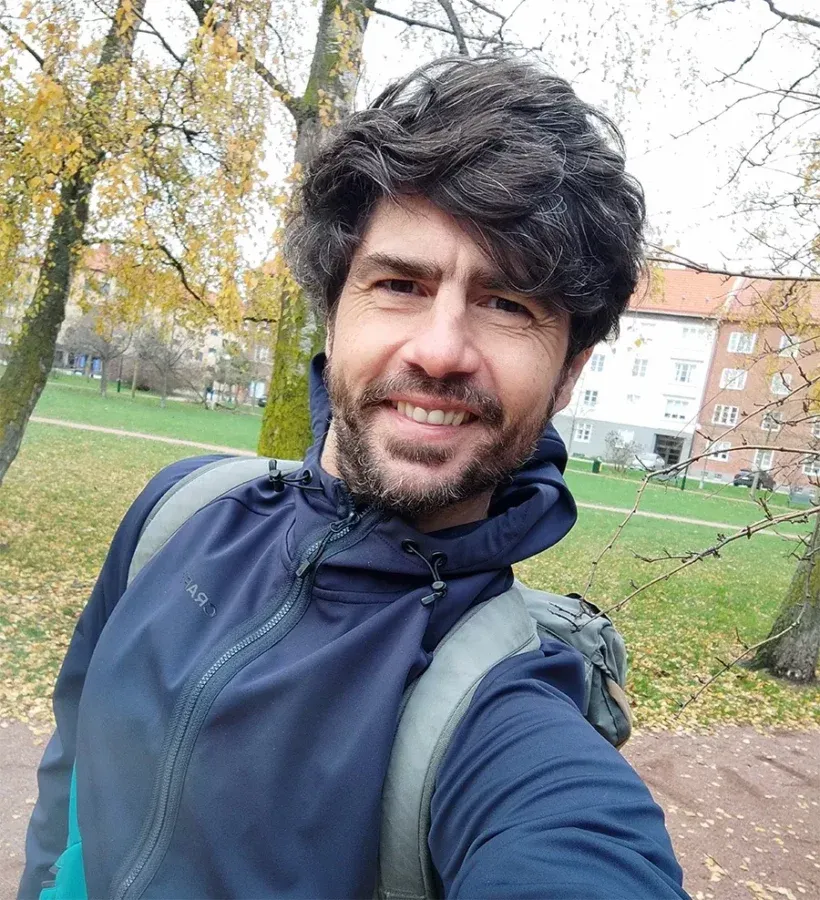
I’m Pedro, a Portuguese teacher based in Sweden, though I didn’t set out to be one.
I trained as an economist in Portugal and came to Sweden at 29 to study Human Ecology. A Brazilian friend who taught evening Portuguese classes needed someone to take over, and I said yes, mostly because I needed the work. That was around 2016. I never left.
Learning from the other side
What shaped how I teach more than anything else is that I’ve been on the other side. Learning Swedish from scratch as an adult, in a country where I needed the language to function, gave me a ground-level understanding of what the process actually feels like. I went through the grammar-nerd phase myself: drills, rules, the satisfying sense of control that comes with structured study.
The ones who knew the most grammar were often the quietest.
But after years of living and speaking Swedish, two things stood out. I had neglected the sound system. My brain was mapping Swedish sounds to the closest Portuguese equivalents, which meant I wasn’t really hearing the language correctly, and that held back both my comprehension and my pronunciation in ways I hadn’t expected. And knowing a lot of grammar had made me self-conscious. I was so focused on getting things right that I held back. I noticed the same pattern later in my students: the ones who knew the most grammar were often the quietest.
What Portuguesepedia is built around
I’m not anti-grammar. It has its place, and I still teach it in classroom settings. But I don’t think it should be the center of gravity, especially for learners trying to close the gap between textbook Portuguese and real spoken EP. That conviction is what Portuguesepedia is built around. The platform started as a blog in 2018, became portuguesepedia.com around 2020, and evolved into a subscription platform in early 2024. Everything in the library is something I’ve chosen, written, and curated myself: every piece of audio, every exercise, every idiom.
I enjoy the creative process behind this and put real effort into it. If you want to share your language learning experience, make a suggestion, or just talk about learning Portuguese, you’re always welcome to reach out.
Pedro
You passed A2. Now close the gap.
Best for learners A2 and up who want better listening, more natural phrasing, and real confidence in European Portuguese.