
Report a problem

Report a problem
Reads

Your Portuguese Learning Library. One Read at a Time.

Built for the hard part of European Portuguese.

Best for learners A2 and up who can read the language but still struggle to follow real speech and sound natural.

start free

No card required

How to Pronounce the Letter S in Portuguese

LEVEL Open TOPIC Pronunciation consonants

Let’s learn how to pronounce the letter S in Portuguese, or I should say European Portuguese, to be more precise.

As you may know, one letter can render different sounds depending on its position in the word. For instance, the letter S can make 4 different sounds (/s/, /z/,  /ʃ/, and /ʒ/). Let’s take a look at what these sounds are and when to pronounce either.
/s/-sound

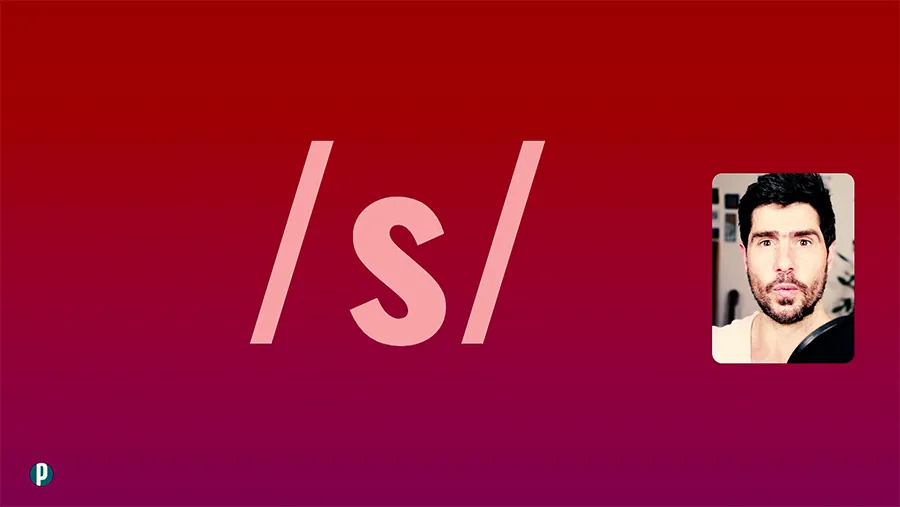
The /s/-sound – technically known as a “voiceless alveolar sibilant” – is what you hear in English words such as simple or awesome. Here are the situations where the letter S renders the /s/-sound:

  1. S at the beginning: sumo, saco, sino, santo
  2. S preceded by a consonant, usually r or n: curso, arsenal, tenso, Afonso
  3. Double S in between vowels: assim, pressa, processo, sessão

/z/-sound

The /z/-sound – technically known as a “voiced alveolar sibilant” – is what you hear in English words such as zebra or zest. There’s only one instance where S renders the /z/-sound:

  1. S in between two vowels: casa, mesa, asa, vaso

/ʃ/-sound

The /ʃ/-sound – technically known as a “voiceless postalveolar fricative” – is what you hear in English words such as sure or cash. There are two instances where S renders the /ʃ/-sound:

  1. S at the end: uvas, bananas, laranjas, peras
  2. S before voiceless consonants: teste, máscara, mosca, espera

/ʒ/-sound

The /ʒ/-sound – technically known as a “voiced postalveolar fricative” – is what you hear in English words such as measure or treasure. There’s one instance where S renders the /ʒ/-sound:

  1. S before voiced consonants: esboço, prisma, desde, desvio

And that’s it for the S letter and how to pronounce it. If you want to dive deeper into the Portuguese sound system, consider taking a look at my in-depth course Portuguese Sounds where I break it all down for you.


Real European Portuguese is harder than the textbook

If you can read Portuguese but real speech is still hard to follow, Portuguesepedia is built for that gap. A deep library of real EP audio, organized by level and topic, with AI-powered practice built in.

start free

No card required.

What learners say

I love the mix of formats. The listening pieces, short reads, exercises, and idioms cover different angles, so I don't get stuck doing the same thing. It keeps me coming back.

~ Olivia ~

It doesn’t feel like studying in the boring sense. The tone is light, but the practice is solid, and I’ve noticed I can put sentences together more easily.

~ Giulia ~

Everything feels well put together. I'll listen to something at my level, check a quick explanation when I'm confused, and then do a practice exercise. Everything I need is in one place and easy to find.

~ Liam ~

Portuguese used to feel messy, like I was putting in effort but not getting results. With Portuguesepedia, I can focus on what I actually need, and I’ve started noticing real improvement week by week.

~ Ebba ~

Something clicked after a few weeks. Real Portuguese started making more sense — not just on paper, but when I'm actually listening. I hadn't felt that kind of progress before.

~ Maria ~

I’d been trying to learn Portuguese for years, but I never felt confident using it. Textbooks were too much, and speaking classes made me freeze. With Portuguesepedia, things finally started to make sense.

~ Emely ~