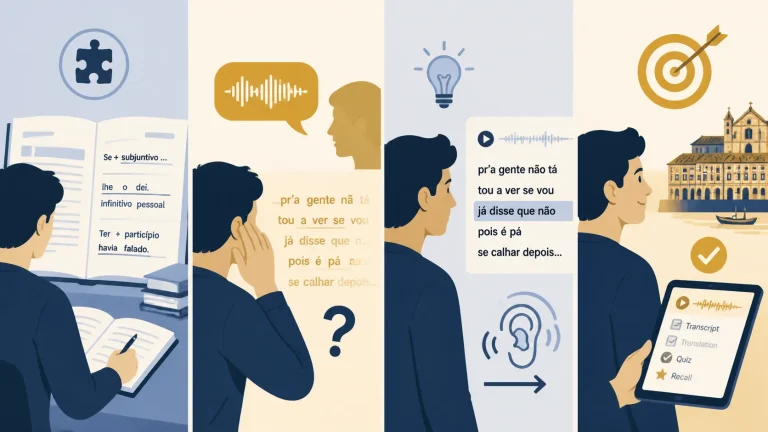
Why More Grammar Study Won’t Fix Your Portuguese Listening
You know what the subjunctive is for. You can spot a personal infinitive. Hand you a paragraph of European Portuguese and you will work through it, slowly…
You know what the subjunctive is for. You can spot a personal infinitive. Hand you a paragraph of European Portuguese and you will work through it, slowly…
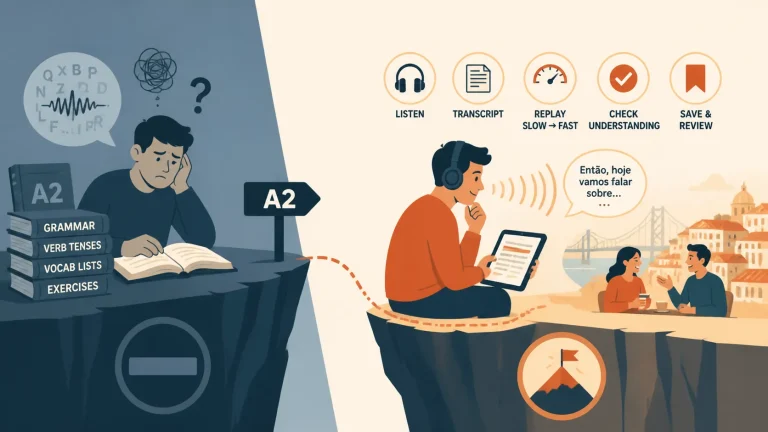
You reached A2. You can read a menu, follow a graded reader, fill in the gaps on a worksheet, maybe hold a slow, careful exchange with someone…
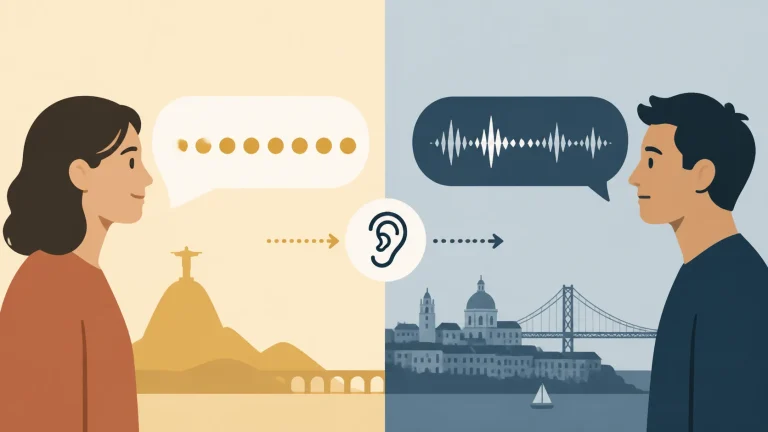
If you started learning Portuguese with Duolingo, a popular YouTube channel, or a telenovela, there’s a good chance you were learning Brazilian Portuguese without realizing it was…
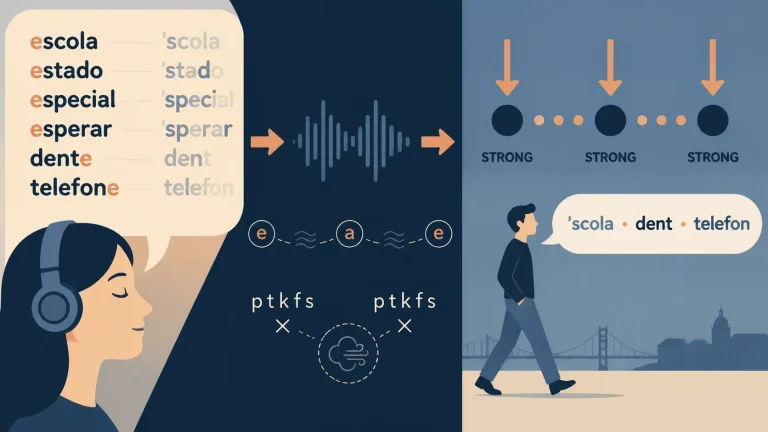
I’ve written before about why you can read European Portuguese fine and still lose the thread the moment someone actually talks to you . Vowel reduction is…
Short answer: not really, not yet. If you’ve found Dreaming Spanish, worked through their levels, and started looking for the same thing in European Portuguese, I want…

Portugal is one of the most Catholic countries in Europe. For centuries, the Church sat at the center of Portuguese life: in the schools, the calendar, the…
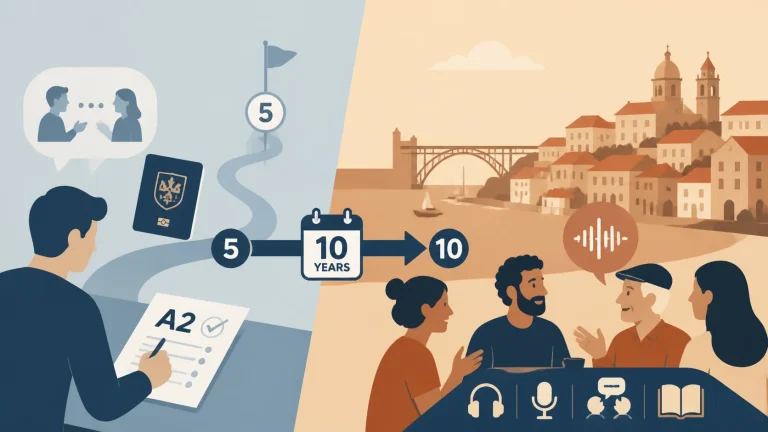
In May 2026, Portugal’s new nationality law came into force. The residency period required for citizenship went from five years to ten for most applicants, and from…
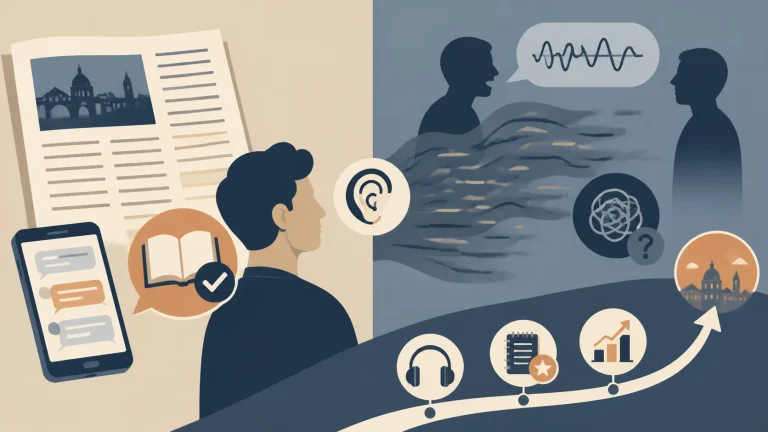
You can read a Portuguese newspaper article and follow it. You can work through a text message from a Portuguese friend without much trouble. Then someone starts…

Most Portuguese learners are well acquainted with hoje, ontem and amanhã, but get stuck when they need to say “last” and “next” with weeks, months, or years.…

Many learners assume the gerund is only used in Brazilian Portuguese. That is not true. In European Portuguese, the gerund exists, but it is used in more…

Learners of Portuguese are often taught a simple rule: tu is informal, você is formal. While this is technically correct, it does not reflect how European Portuguese…

When you start talking about the past in Portuguese, you quickly run into a practical problem: you want to describe lots of different activities, but each one…

The Pretérito Perfeito is the past tense used to talk about completed actions in the past. It is used for actions that started and ended at a…

The pretérito perfeito is used to describe completed actions in the past. Many of the most common Portuguese verbs are irregular in this tense, which means their…

In European Portuguese, the vowel e can represent several different sounds, depending on position and stress. This article does not cover all of them.Here, the focus is…

When talking about events that are not certain, European Portuguese offers several common expressions to convey probability or uncertainty. These expressions do not all behave the same…

When you want to describe something that is happening at this exact moment in European Portuguese, you use a very specific and consistent structure. This structure is…

One of the most persistent difficulties for learners of Portuguese is knowing when to use the pretérito perfeito and when to use the pretérito imperfeito. Both are…