Report a problem

Report a problem
Reads

Your Portuguese Learning Library. One Read at a Time.

Built for the hard part of European Portuguese.

Best for learners A2 and up who can read the language but still struggle to follow real speech and sound natural.

start free

No card required

How Passive Listening Can Boost Your Language Learning

LEVEL Open TOPIC Tips & Tricks how to

Learning a new language can feel overwhelming, especially at the start. One powerful yet often underrated tool is passive listening—the art of absorbing the language without focusing on semantics. 

Let’s dive into how passive listening can accelerate your learning journey.

What is Passive Listening?

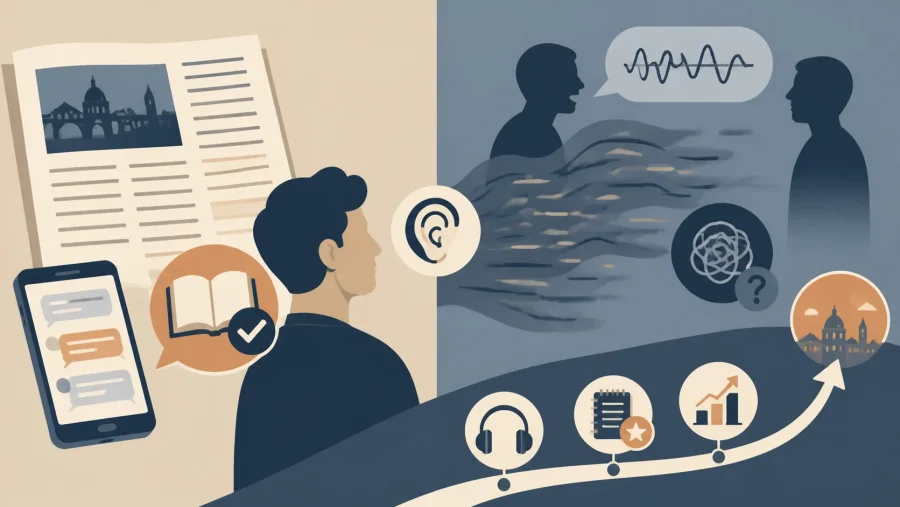
Imagine this scenario: You’re cooking dinner while listening to a podcast in Portuguese. As a beginner, you won’t understand every word or the full meaning of what’s being said. While you might only catch a few familiar phrases, you’re still surrounding yourself with the language. This is passive listening in action (pun intended).

Even if you don’t understand the full content, passive listening helps you absorb key elements of the language such as pronunciation, rhythm, and intonation. Over time, this exposure to the sounds of Portuguese will improve your listening comprehension and speaking skills. Let’s see in more detail how it works.

How Passive Listening Enhances Language Learning

  1. Subconscious Exposure to the Language. When you listen to Portuguese, even if you’re not focusing on comprehension, your brain is still processing the sounds and structure of the language. Over time, this repetitive exposure helps reinforce your natural feel for how Portuguese sounds, improving your overall fluency.
  2. Improves Listening and Pronunciation Skills. By constantly hearing native speakers, you become attuned to the natural flow of the language. This helps you mimic correct pronunciation and intonation when speaking. The more you listen to authentic Portuguese conversations, the easier it becomes to replicate the sounds and rhythm in your speech.
  3. It’s Effortless Learning. One of the most appealing aspects of passive listening is that it’s incredibly easy to incorporate into your daily routine. You can listen to Portuguese podcasts, TV shows, or music while doing other tasks like cooking, commuting, or exercising. It doesn’t require any extra effort, yet it helps reinforce your language skills.

How to Get the Most Out of Passive Listening

To maximize the benefits of incidental listening, here are some tips for beginners:

  1. Focus on Phonetics, Not Meaning. Instead of stressing over understanding every word, pay attention to the sounds, rhythm, and intonation of the language. This will help your ear get accustomed to Portuguese speech patterns and improve your listening skills over time.
  2. Make It a Habit. To make passive listening part of your routine, try integrating it into your daily activities. Listen to Portuguese while doing chores or during your commute. Over time, this consistent exposure will gradually improve your language skills.

Complement Passive Listening with Active Listening

While passive listening is an excellent tool, it’s most effective when paired with active listening. Active listening involves paying close attention to semantics to understand what you are listening to. 

Combining the two approaches will help you build a solid foundation of comprehension and speech. Over time, you’ll notice significant improvements in your ability to understand and speak Portuguese.

These Listening Drills give all the tools to practice active listening effectively.

To recap, passive listening is a game-changer for language learners, not least beginners. It’s a fun, easy, and effective way to immerse yourself in the Portuguese language (or any other) without the pressure of trying to understand everything right away. Start incorporating passive listening into your daily routine and watch your fluency improve over time.


Real European Portuguese is harder than the textbook

If you can read Portuguese but real speech is still hard to follow, Portuguesepedia is built for that gap. A deep library of real EP audio, organized by level and topic, with AI-powered practice built in.

start free

No card required.

What learners say

I love the mix of formats. The listening pieces, short reads, exercises, and idioms cover different angles, so I don't get stuck doing the same thing. It keeps me coming back.

~ Olivia ~

It doesn’t feel like studying in the boring sense. The tone is light, but the practice is solid, and I’ve noticed I can put sentences together more easily.

~ Giulia ~

Everything feels well put together. I'll listen to something at my level, check a quick explanation when I'm confused, and then do a practice exercise. Everything I need is in one place and easy to find.

~ Liam ~

Portuguese used to feel messy, like I was putting in effort but not getting results. With Portuguesepedia, I can focus on what I actually need, and I’ve started noticing real improvement week by week.

~ Ebba ~

Something clicked after a few weeks. Real Portuguese started making more sense — not just on paper, but when I'm actually listening. I hadn't felt that kind of progress before.

~ Maria ~

I’d been trying to learn Portuguese for years, but I never felt confident using it. Textbooks were too much, and speaking classes made me freeze. With Portuguesepedia, things finally started to make sense.

~ Emely ~